Specimen 005/006
- Status Archive · Verified
- Ref ENG-005
- Sector Education
- Log entries 08
- Trace Intact
Mandate
A K-8 public charter school — small, place-based, built on an academic model with no local equivalent — was forced off its campus in the middle of an enrollment collapse: a 29 percent enrollment gap, roughly $630K of annual revenue gone, reserves measured in days. The mission was excellent. Excellence was not the problem.
Mission strength does not guarantee institutional sustainability. What the school lacked was not conviction but architecture: no revenue diversification, no enrollment engine, no operational systems, no sequenced path from survival to stability.
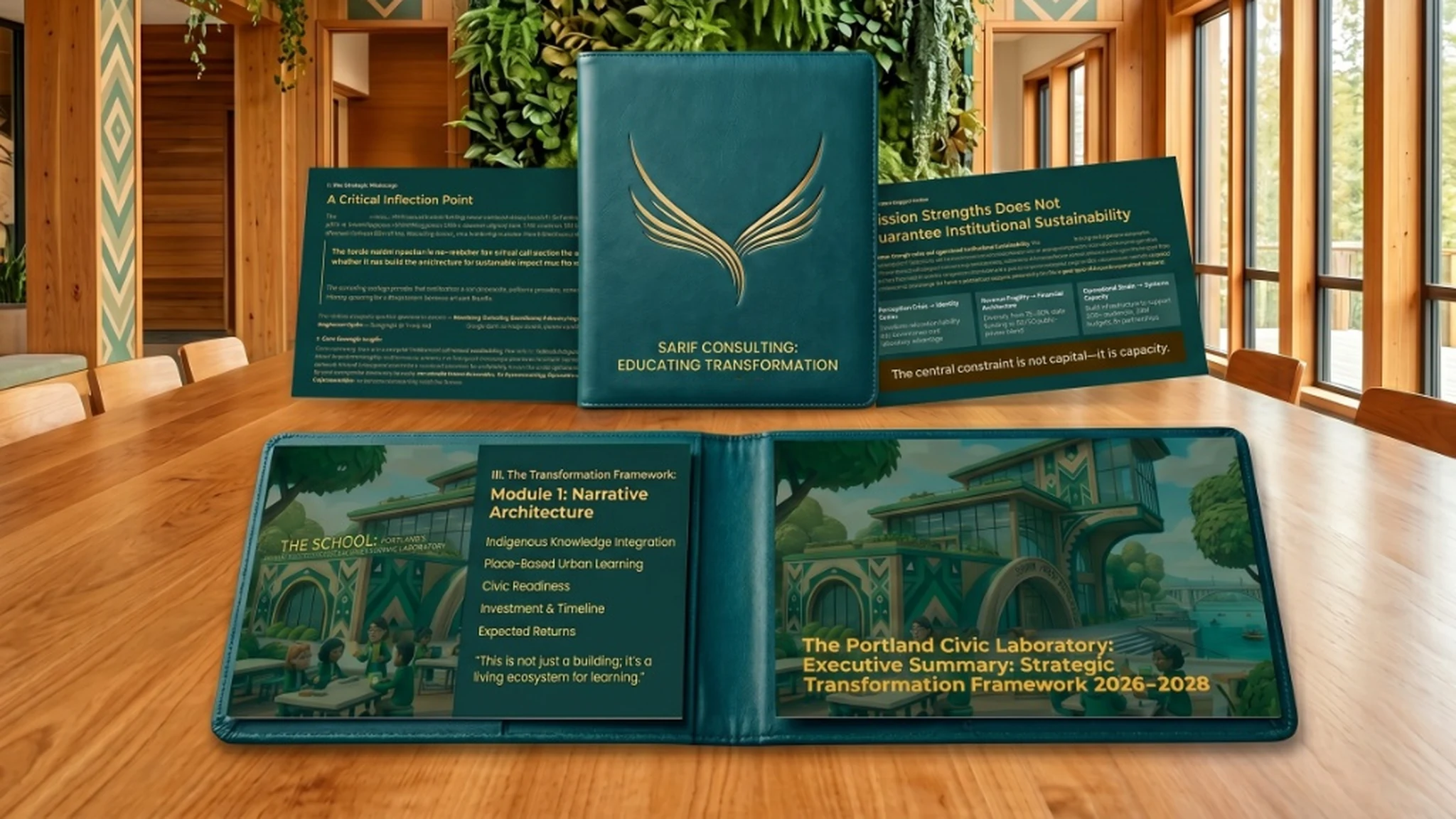
We built the architecture: seven modules across six interdependent domains — narrative, financial, enrollment, partnership, operational, implementation — sequenced across 36 months and costed against probability rather than hope. The seventh module is the one most consultancies omit: a register of thirty-five assumptions, each flagged for validation, delivered with the standing instruction to treat the plan as hypotheses to be tested rather than certainties to be executed.
Operations log
-
Seven modules across six interdependent domains — narrative, financial, enrollment, partnership, operational, implementation — with the assumption register as the seventh
-
Repositioning from crisis to category: the relocation liability reframed as the market advantage — the city's downtown civic laboratory
-
Financial architecture: state-funding dependency cut from 75–80% toward a balanced public-private blend; $712K–$1.29M capital plan across 36 months
-
Partnership portfolio engineered at 3.5–6.9x projected ROI — university academic pipeline, compensated Indigenous educator collaboration, corporate anchors, civic alliances
-
Enrollment recovery mechanics: stay conversations with every enrolled family, proximity-based acquisition, a 90–93% retention target
-
Annual hidden costs of $243K–$473K surfaced and itemized — staff time drag, lost enrollments, turnover, missed partnership value
-
The honesty layer: every assumption named and dated for validation, the plan handed over as hypotheses to test rather than certainties to execute
-
Complete framework delivered as one integrated package — executive summary through 36-month implementation roadmap.