Praxis No. 03 — Methodology
Pipelines Move Forward. Systems Circulate.
The difference between a workflow and a methodology is not speed. It is whether downstream output changes upstream state. A note on circulation as architecture.
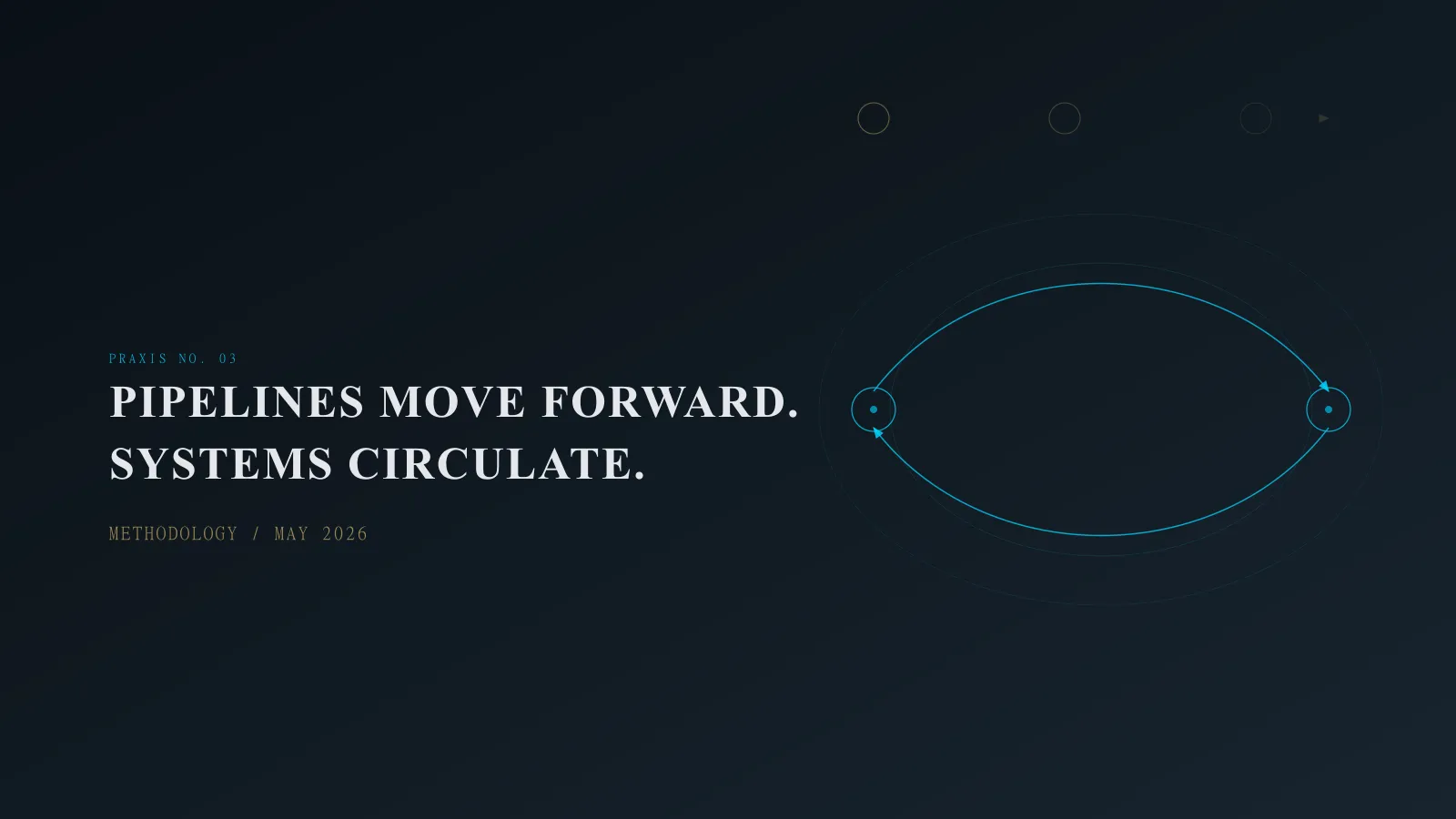

Most AI-augmented workflows are pipelines. Surface A produces. Surface B refines. Surface C formats. The work moves in one direction. Each stage receives the output of the previous stage, operates on it and passes the result forward.
This is sequential handoff with different tooling. The shape is the same shape consulting has always used — strategist to analyst to designer to project manager to partner review — compressed in time but unchanged in structure. And the structural problem is unchanged too: each handoff is a compression event. The reasoning that connected one stage to the next gets summarized, the summary replaces the reasoning, and the next surface works from the summary rather than from the structure.
Pipelines produce Coherence Decay Coherence Decay The degradation that occurs when work passes through too many hands, too many meetings or too many translation layers. Every handoff strips context. Every summary compresses nuance. By the time a strategy reaches execution, or a diagnosis reaches the decision-maker, most of the original signal has been lost. Coherence decay is why large firms produce thick decks with thin insight. Related Trace Jensen Metabolic Knowledge Referenced by Metabolic Knowledge UCIM — Universal Contextual Intelligence Matrix Trace Briefing Praxis Open in atlas . Not because the surfaces are weak. Because the architecture only moves forward.
What circulation looks like
A strategic position is developed on a surface built for long-arc reasoning. It produces a structured claim with four load-bearing arguments. That structure moves to a second surface built for adversarial stress-testing. The stress test identifies three assumptions underneath the position. One of them undermines the second argument entirely.
The pipeline move is to revise the second argument and continue forward. The circulation move is different. The stress-test output returns to the first surface — not as a correction to the second argument but as new context for the entire position. The first surface is now reasoning against a richer model of the work than it held on its first pass. What it produces is not a revision. It is a different position, one that has incorporated downstream feedback into the upstream frame.
That updated position returns to the stress-testing surface. The second pass surfaces a different set of assumptions, because the position has genuinely changed rather than merely been edited. Each loop adds relational density. Each pass raises the resolution of the whole.
The output of a circulating system is not the product of any single surface. It is the product of the conversation between them. The artifact is almost incidental. What moves between surfaces is the accumulated understanding of the work, updated as the system responds to its own reasoning.
Why the direction decides the ceiling
The distinction between pipeline and circulation is not a workflow preference. It is the structural determinant of whether an AI-augmented practice produces traceable depth or merely architectural speed.
A pipeline can be fast. It can produce volume. It can compress weeks of sequential review into days. But if the architecture only moves forward, the output carries the same structural limitation as the traditional model it replaced: every stage operates on a progressively thinner representation of the original reasoning. The last stage — the one that produces the deliverable the client actually reads — is the stage furthest from the structural foundation the work was built on.
Circulation inverts this. The last pass through the system is the most informed pass, not the least. Downstream surfaces have already tested the position. Upstream surfaces have already incorporated those tests. The deliverable that ships is not the endpoint of a sequence. It is the settled state of a system that has been updating itself against its own reasoning.
The school arrived with a downstream problem: forced off campus, a 29 percent enrollment gap, roughly $630K of annual revenue gone. A pipeline treats that as the input to a recovery plan. Circulation sent it back up: the relocation stopped being the liability the plan had to survive and became the position the plan was built on — the city’s downtown civic laboratory. The finding did not get solved at the stage where it appeared. It rewrote the frame above it.
This is how Sarif’s engagements actually work. Jensen Jensen Jensen is Sarif's intelligence layer. A graph-grounded reasoning system that metabolizes every engagement's context into a persistent operating memory. Jensen is how a single operator runs work that would otherwise require a team: research, synthesis, modeling, strategy, documentation and risk analysis are orchestrated through one coherent substrate rather than distributed across disconnected roles. Related UCIM Metabolic Knowledge Trace Referenced by Augment Your Intelligence Coherence Decay UCIM — Universal Contextual Intelligence Matrix Trace Open in atlas does not process an engagement in stages. Research, synthesis, modeling, strategy, documentation and risk analysis are orchestrated through one substrate rather than queued behind one another, so a finding from the risk analysis does not wait for the strategy to be finalized before it reshapes the strategy. It reshapes it while the strategy is still being formed, because the architecture permits return paths and not only forward paths.
The clearest artifact of that architecture is the one most engagements omit. Engagement 005 shipped seven modules across six interdependent domains, and the seventh module was a register of thirty-five assumptions, each named and dated for validation, handed over with the standing instruction to treat the plan as hypotheses to be tested rather than certainties to be executed.
35
That register is a return path built into the deliverable. It tells the client which parts of the position are load-bearing and unproven, so that what they learn in month eight can circulate back into the plan rather than quietly invalidate it. A pipeline cannot ship that document, because a pipeline has no mechanism for receiving what comes back.
The connection to the matrix
UCIM UCIM — Universal Contextual Intelligence Matrix UCIM is the framework Jensen runs on. A living knowledge genome that ingests signals from documents, conversations, tool integrations and decision history, then organizes them into a contextual graph that evolves with use. Concepts are reinforced when they prove useful and decay when they fall out of relevance, so the matrix stays current without manual curation. Related Jensen Metabolic Knowledge Coherence Decay Referenced by Augment Your Intelligence Metabolic Knowledge Jensen Open in atlas is the substrate that makes circulation possible across engagements, not only within them. When a concept is activated in one engagement and stress-tested in another, that reinforcement is itself a circulation — downstream experience updating upstream knowledge. The three metabolic states described in Praxis No. 02 are the long-cycle version of what happens inside a single engagement. Fresh, Latent and Decaying are the graph-level evidence of a system that circulates rather than archives.
Every engagement that ships changes the state of the matrix. The matrix that the next engagement reasons against is not the matrix the previous engagement started from. The system does not reset between clients. It updates.
Pipelines produce deliverables. Circulation produces intelligence. That distinction is why the same practice can ship a ten-chapter civic policy playbook and a five-node regulated intake architecture — different sectors, different evidentiary standards, different failure modes — without rebuilding its reasoning apparatus in between. The apparatus is not rebuilt per engagement. It is the thing the engagements keep depositing into.
What this is not
It is not a claim that pipelines are useless. For well-defined production tasks with stable inputs — formatting, rendering, data transformation — sequential processing is correct, and a return path would only add cost. The argument is specific to reasoning work: strategy, analysis, synthesis, design. Work where the quality of the output depends on how many times the position was tested against itself before it shipped.
It is also not a claim about tool count. Circulation does not require more surfaces. It requires return paths between them. A two-surface system with genuine feedback loops will outperform a ten-surface pipeline on any work that requires coherence, because the two-surface system updates its own state and the ten-surface pipeline does not.
The architecture is the methodology. Not the tools. Not the sequence. The presence or absence of return paths.
Every loop, every state update and every stabilization point is recorded in the Trace Trace The full record of how a conclusion was reached. For Sarif, every deliverable carries a trace: which sources were consulted, which concepts activated, which inferences were labeled as grounded, inferred or uncertain, and which risks were flagged along the way. Trace is not appendix material. It is the audit surface that makes the conclusion trustworthy. Related Epistemic Mode Coherence Decay Jensen Referenced by Augment Your Intelligence Coherence Decay Metabolic Knowledge Jensen Epistemic Mode Briefing Praxis Open in atlas that accompanies a Sarif engagement. If you want to see what a return path looks like on your own problem, send a transmission and we will show you the record.
Continue