Praxis No. 05 — Field Observation
Signal Without Noise
Every claim in a Sarif deliverable is tagged as grounded, inferred or uncertain before it ships. That is not a quality layer. It is the product itself.
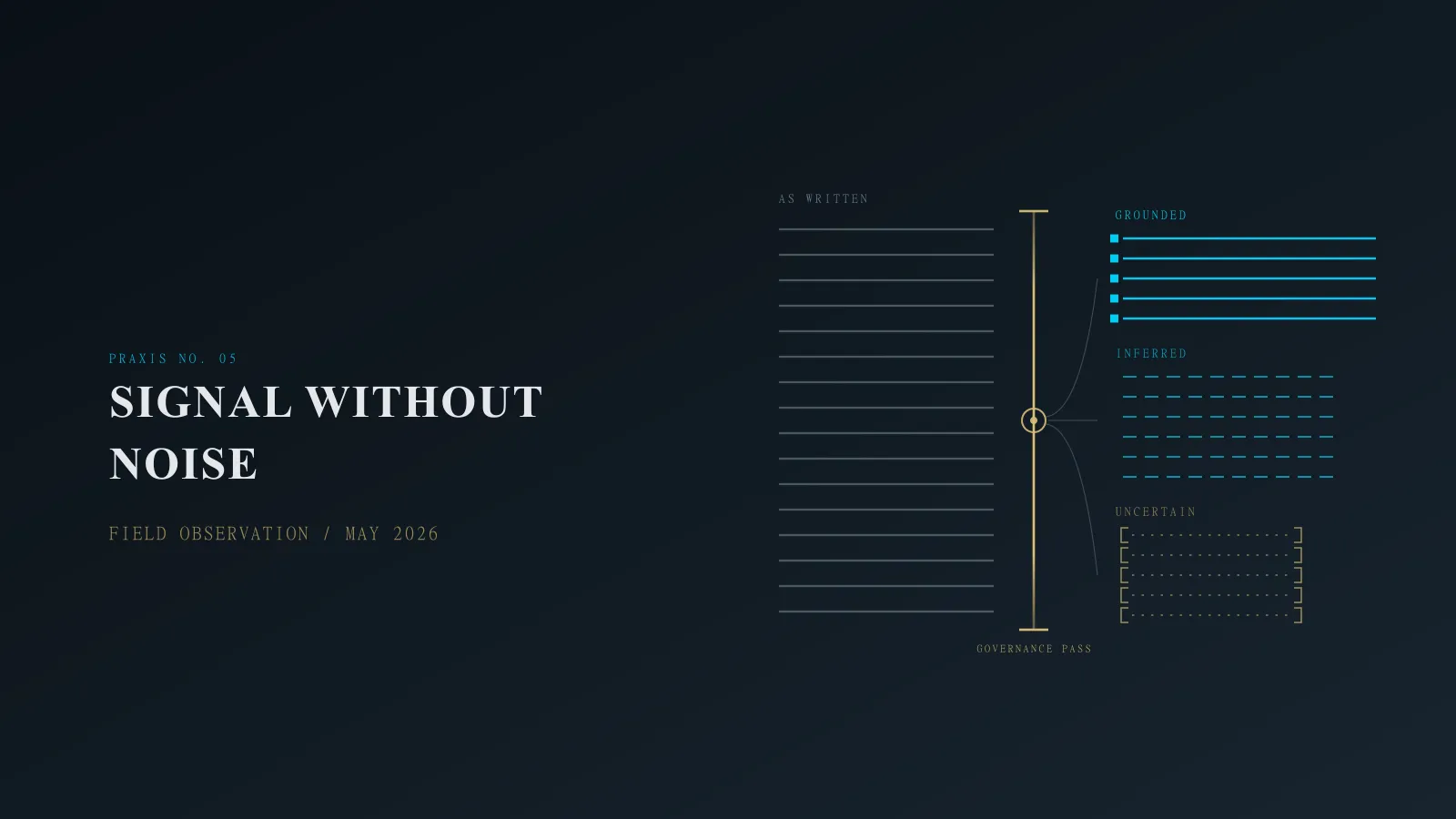

Most consulting deliverables are written in a single register: confident prose. The recommendation sounds certain. The forecast sounds certain. The risk assessment sounds certain. The client reads the document and has no structural way to distinguish between a claim supported by three independent sources, a claim inferred from adjacent evidence, and a claim that represents the consultant’s best guess in the absence of data.
All three look the same on the page. That is the noise.
What Epistemic Mode is
Every substantive claim in a Sarif deliverable carries a tag. Three possible values:
Grounded. Directly supported by source material that the client can inspect. The source is named. The reasoning chain from source to claim is in the Trace Trace The full record of how a conclusion was reached. For Sarif, every deliverable carries a trace: which sources were consulted, which concepts activated, which inferences were labeled as grounded, inferred or uncertain, and which risks were flagged along the way. Trace is not appendix material. It is the audit surface that makes the conclusion trustworthy. Related Epistemic Mode Coherence Decay Jensen Referenced by Augment Your Intelligence Coherence Decay Metabolic Knowledge Jensen Epistemic Mode Briefing Praxis Open in atlas . If the source is challenged, the claim falls with it — and the system knows which other claims depended on it.
Inferred. Reasoned from evidence but not explicitly stated in any source. The inference is labeled. The evidence it rests on is named. The logical step between evidence and claim is visible. A reader who disagrees with the inference can locate exactly where their reasoning diverges from ours.
Uncertain. Sarif’s best read of a situation where the evidence is incomplete, conflicting or absent. The uncertainty is not hidden. It is surfaced, bounded and — where possible — accompanied by what would need to be true for the uncertainty to resolve in each direction.
Why this matters more than it sounds
The obvious value is transparency. Clients know what they are looking at. That is real but it is not the structural point.
The structural point is that Epistemic Mode Epistemic Mode The honesty layer on every Sarif output. Every substantive claim is tagged as grounded (directly supported by source material), inferred (reasoned from evidence but not explicitly stated) or uncertain (Sarif's best read, flagged as such). Clients never have to guess which is which. Ambiguity is surfaced, not hidden behind confident prose. Related Trace Metabolic Knowledge Briefing Referenced by Trace Briefing Open in atlas makes a deliverable adversarially survivable. When a claim is challenged — by a board member, a regulator, an opposing counsel, a skeptical funder — the response is not “trust us” or “our methodology is rigorous.” The response is: here is the tag. Here is the source. Here is the reasoning chain. Here is where your challenge would need to land to invalidate the claim.
A deliverable without epistemic tagging can only be defended in aggregate. “We did thorough research.” A deliverable with epistemic tagging can be defended at the claim level. Each assertion carries its own structural integrity independent of the document around it.
A 17-tab financial model, Workbook v1.3 canonical: $179.3M base-case project cost against $127.2M assembled capital. The gap — $52.1M — was published as a gap, not narrowed by assumption. Seventy-three assumptions were named and registered rather than absorbed into the base case. The workbook carried its own boundary on its face: institutional-grade analysis, not bankable underwriting. Architectural-historian peer review was absorbed across four versioned passes inside a live appeal window, and each pass could be re-entered at the claim level because every figure already knew what kind of claim it was.
$52.1M
What the client actually sees
A Sarif deliverable does not render epistemic tags as colored highlights or margin annotations. The tagging lives in the Trace — the full audit record that travels with the document. A client reading the deliverable reads clean prose. A client inspecting the Trace sees every claim decomposed into its epistemic classification, its source chain and its dependency structure.
This is deliberate. The deliverable is optimized for decision-making. The Trace is optimized for accountability. Both ship. The client chooses the surface appropriate to their need at any given moment.
The relationship to noise
Noise in consulting output is not inaccuracy. Most consulting firms produce accurate documents. The noise is undifferentiated confidence — the inability to tell, from the prose alone, which claims are load-bearing and which are speculative, which rest on primary evidence and which rest on analogy, which would survive challenge and which would not.
Epistemic Mode eliminates undifferentiated confidence. It replaces the single register of “we recommend” with a three-register system where the strength of each assertion is structurally visible. A client can read a Sarif deliverable and know, before acting on any specific claim, how much weight that claim can bear.
That is signal. Everything else — the confident prose that gives every assertion equal weight regardless of evidentiary backing — is noise dressed in professional formatting.
What this costs
Tagging is not free. It adds time to the governance pass. Every claim must be evaluated, classified and — if grounded — source-linked before it ships. The process is not automated. Jensen Jensen Jensen is Sarif's intelligence layer. A graph-grounded reasoning system that metabolizes every engagement's context into a persistent operating memory. Jensen is how a single operator runs work that would otherwise require a team: research, synthesis, modeling, strategy, documentation and risk analysis are orchestrated through one coherent substrate rather than distributed across disconnected roles. Related UCIM Metabolic Knowledge Trace Referenced by Augment Your Intelligence Coherence Decay UCIM — Universal Contextual Intelligence Matrix Trace Open in atlas flags candidates. The principal makes the classification decision. The Trace records both the flag and the decision.
The cost is structural rigor at the production layer. The return is a deliverable that does not degrade under scrutiny. For work that will be acted on — policy decisions, capital allocation, regulatory submissions, board-level strategy — the tradeoff is not close.
What this is not
It is not hedging. A tag is not a disclaimer, and “uncertain” is not a way to avoid taking a position. The uncertain claims in a Sarif deliverable still carry a recommendation; what they additionally carry is the condition under which that recommendation would change. Hedging withholds the position. Tagging states the position and exposes its load limit.
It is not a confidence score. There is no percentage, no five-point scale, no numeric weighting that invites the client to average across claims. Three values, applied structurally, because a number implies a precision the underlying evidence does not have — which would reintroduce exactly the false uniformity the tagging exists to break.
It is not a substitute for judgment. Tagging tells the client what kind of claim they are holding. It does not tell them what to do with it. A grounded claim can still be strategically wrong; an uncertain claim can still be the one worth acting on first. The classification describes evidentiary standing, not priority. Deciding what to act on remains the client’s, informed by Praxis No. 02 — every claim also carries its metabolic context, and a grounded claim from a decaying source is not the same instrument as a grounded claim from a fresh one.
And it is not free at the margin. Where the evidence base is thin, tagging makes thinness visible rather than papering it over. That has cost us the comfortable version of a finding more than once. It has never cost us the finding.
Signal without noise is not a marketing claim. It is what a deliverable looks like when every assertion carries its own evidentiary weight and admits its own limits before the client has to ask.
Sarif Briefings ship with full Trace and Epistemic Mode tagging as baseline. No premium tier. No add-on. The honesty layer is the product. If you have a decision that needs to survive scrutiny rather than merely sound confident, send a transmission .
Continue