Specimen 003/006
- Status Archive · Verified
- Ref ENG-003
- Sector Legal services
- Log entries 08
- Trace Intact
Mandate
A B Corp personal injury firm was losing after-hours callers to whichever firm answered first. The obvious fix — an automated voice answering as the firm — collided with the brand: trauma-informed, human-first, bilingual. The wrong intake voice would cost more than the missed calls.
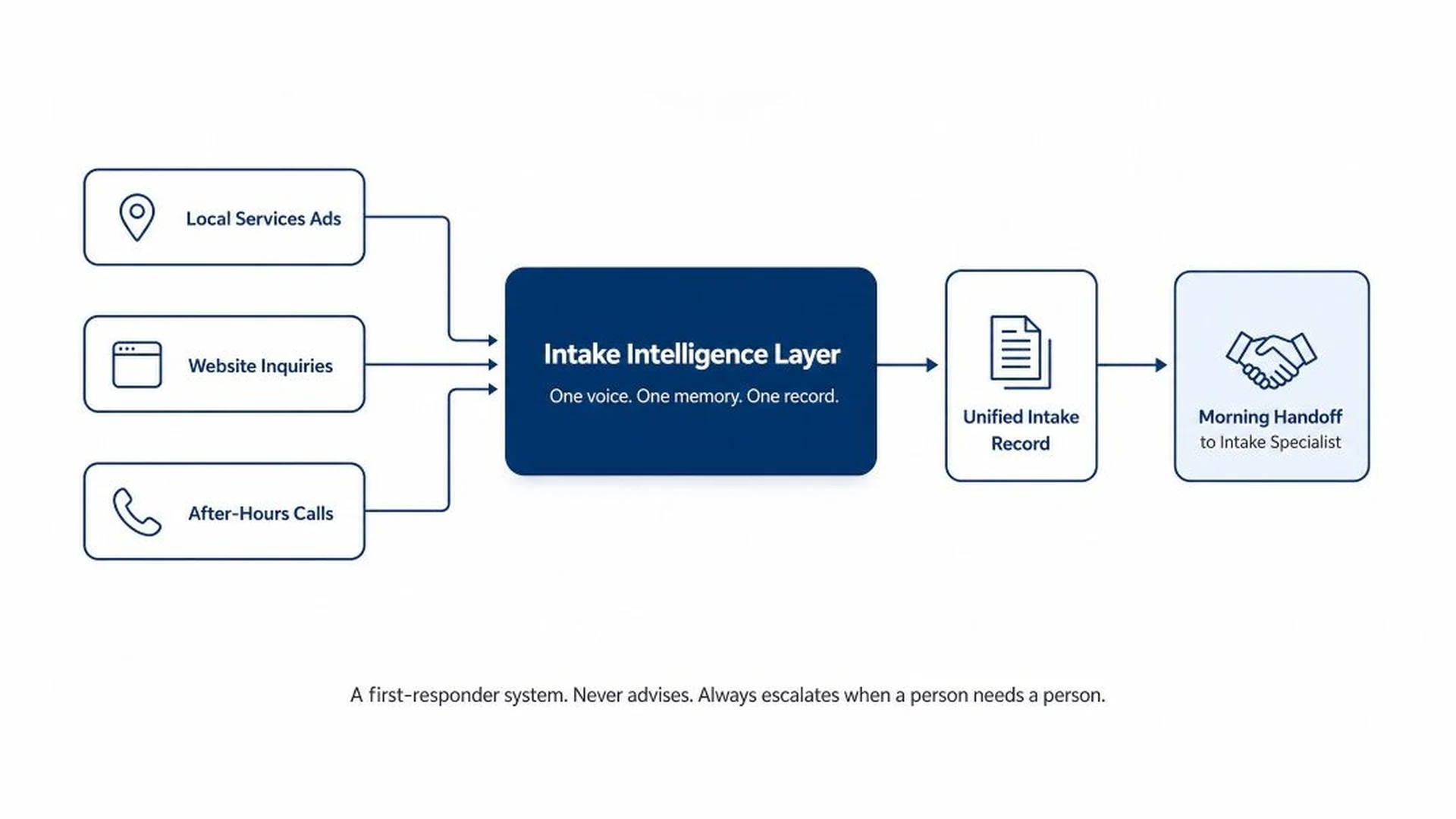
The product was a bespoke intake intelligence layer: one regulated voice across three intake channels — Local Services Ads, Website Inquiries, After-Hours Calls — unified into a single record. One voice. One memory. One handoff.
Legal intake is a regulated act. Oregon State Bar Formal Opinions 2026-208 and 2025-205 bound what an automated system may say, collect and promise — and no off-the-shelf intake product was built to that constraint set. We designed around it: a five-node architecture — Reception, Listening, Gathering, Discernment, Handoff — with constrained decoding, bilingual parity and a morning handoff that returns judgment to the attorneys. AI captures. Humans decide. The complete design architecture — voice, compliance, routing, escalation — was delivered as a fixed-fee first phase, with build scoped as a separate decision.
Operations log
-
Three intake channels — Local Services Ads, Website Inquiries, After-Hours Calls — unified through a bespoke intake intelligence layer
-
Five-node intake architecture — Reception, Listening, Gathering, Discernment, Handoff — under constrained decoding
-
Compliance architecture mapped to OSB Formal Opinions 2026-208 (chatbots and AI agent communications) and 2025-205 (AI tools); UPL boundaries designed in, not bolted on
-
Bilingual Spanish parity with explicit consent design; trauma-informed voice architecture throughout
-
Platform-agnostic technical landscape — ElevenLabs Conversational AI, Vapi, Twilio SIP, Zola CRM — recommendation driven by constraint, not vendor
-
Escalation protocols and morning handoff format — the firm's existing stack extended, not replaced
-
Design review structured for client governance: 17-slide architecture deck, stakeholder input window, executive brief
-
Phase 1 delivered complete under fixed fee: architecture, regulatory analysis, bilingual consent design, routing integration, governance-ready review materials.