Praxis No. 06 — Field Observation
Coherence Decay in Distributed Teams
Handoffs are compression events. Each translation layer strips the connective tissue between claim and reasoning — until the people who act on the work are guessing.
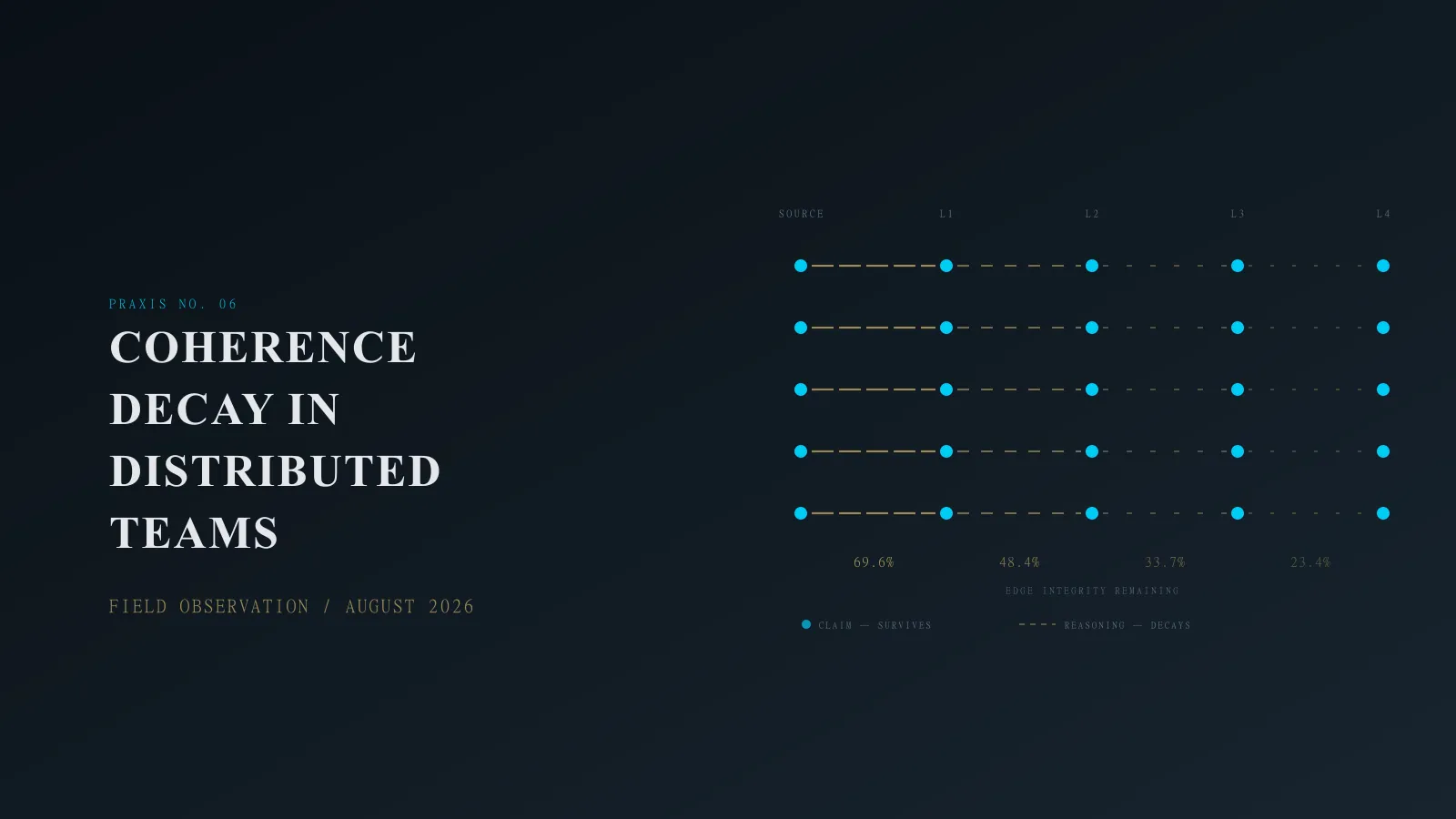

A deliverable is a graph. The nodes are the claims. The edges are the reasoning that connects them — this recommendation exists because of this evidence, this line item assumes this uptake rate, this risk is mitigated by this mechanism. The graph is what makes the deliverable a system rather than a list of assertions.
Coherence Decay Coherence Decay The degradation that occurs when work passes through too many hands, too many meetings or too many translation layers. Every handoff strips context. Every summary compresses nuance. By the time a strategy reaches execution, or a diagnosis reaches the decision-maker, most of the original signal has been lost. Coherence decay is why large firms produce thick decks with thin insight. Related Trace Jensen Metabolic Knowledge Referenced by Metabolic Knowledge UCIM — Universal Contextual Intelligence Matrix Trace Briefing Praxis Open in atlas is what happens to the edges.
The order of decay
Detail is not the first casualty. That is the common assumption and it is wrong. A re-narrated document usually keeps its numbers, its bullet points, its topline recommendations. What it loses — silently, triggering no review flag — is the connective tissue between them.
Three edges die first:
Intervention to evidence. A recommendation that named its comparable case, its measured effect and its follow-up window becomes a recommendation that says research supports it. What remains cannot be challenged at the source, because the source is no longer named.
Line item to assumption. A figure that carried its uptake rate, its horizon and the comparable it was calibrated against becomes a figure. The number survives; the assumption that determines whether it is credible does not.
Risk to mitigation. A contingency that named its trigger and its revised envelope becomes silence. Not a weaker statement. Absence.
In all three the node survives and the edge dies.
This is measured, not asserted
Coherence Decay sounds like a metaphor. It has been quantified, in the most controlled handoff environment there is.
Carter, Davis, Evans and Cone studied trauma handovers at a Level I trauma center and published in Prehospital Emergency Care in 2009: ninety-six handovers, video-recorded, audited element by element against what the receiving team documented. Face-to-face verbal contact, one patient at a time, trained clinicians on both ends — no page budget, no reading-time expectation, no slide count.
Of 473 clinical data elements transmitted, 329 were received. 69.6 percent.
30.4%
The selectivity is the finding. Mechanism of injury was transmitted 94 times and survived; anatomic location 81, age 67. But prehospital hypotension was received in 10 of the 28 times it was transmitted, Glasgow Coma Scale score 10 of 22, pulse rate 13 of 49. What survived identifies the patient. What died determines the treatment.
Now compound it. Analysis to summary to brief to presentation is four handoffs, and at that retention rate four layers leave 23.4 percent of the original signal standing. Two — the minimum any distributed team runs — already lose more than half. That is the arithmetic every organization runs without measuring.
Where the compression happens
Every engagement has a seam: the moment the analytic layer hands its work to the apparatus that will deploy it. The compression there is not malicious or negligent — it is architectural. The one-pager has a page budget, the memo a reading-time expectation, the deck a slide count. Every format constraint that optimizes for the reader’s time optimizes against the reasoning that justifies what they are reading.
Engagement 001 produced a leaders’ brief whose stated purpose was the decision case compressed for a council floor. Compression was the deliverable — which is why the reasoning had to live somewhere the compression could not reach.
Council committed $5.6M. Twelve days later the executing agency had budgeted $0 against it. The commitment survived the handoff intact — the number was never in dispute. What did not survive was the reasoning that made it actionable: which line it belonged against, on whose authority, by when. The gap was caught only because the analytic layer still held the source graph and could re-enter it.
Nobody in that sequence did anything wrong. A format that cannot hold the reasoning will always strip it to fit — a container issue, not a personnel one. Distribution is what makes it structural. A solo practitioner who compresses their own work at least knows what was removed; a team cannot, because Person B never had Person A’s reasoning, only Person A’s document, already one layer removed. By the time the decision-maker asks why this number, the answer requires reconstructing a chain no one in the room holds in full.
And the cost is invisible to the people paying it. Those clinicians did not know what they were missing; neither does any executive reading a brief. Detecting the loss means holding the source and the compressed artifact at once and diffing them, which requires that someone still holds the source graph. In most production systems no one does: the analysis was an intermediate artifact, consumed by the summary and discarded.
The architectural response
Sarif’s answer is not write better summaries. It is structural, in three parts.
Zero-handoff production. One operator holds the reasoning from intake to signed deliverable; whoever derived the conclusion writes the sentence that communicates it. This is the argument of Praxis No. 01, and Coherence Decay is why it is not merely a staffing preference.
Trace Trace The full record of how a conclusion was reached. For Sarif, every deliverable carries a trace: which sources were consulted, which concepts activated, which inferences were labeled as grounded, inferred or uncertain, and which risks were flagged along the way. Trace is not appendix material. It is the audit surface that makes the conclusion trustworthy. Related Epistemic Mode Coherence Decay Jensen Referenced by Augment Your Intelligence Coherence Decay Metabolic Knowledge Jensen Epistemic Mode Briefing Praxis Open in atlas as connective tissue. Every claim is wired to its evidence in the Trace, and when the deliverable is compressed downstream — and it will be — the Trace travels with it. Compression can strip the reasoning from the prose without killing it, because it lives in the audit layer rather than the body copy.
Epistemic Mode Epistemic Mode The honesty layer on every Sarif output. Every substantive claim is tagged as grounded (directly supported by source material), inferred (reasoned from evidence but not explicitly stated) or uncertain (Sarif's best read, flagged as such). Clients never have to guess which is which. Ambiguity is surfaced, not hidden behind confident prose. Related Trace Metabolic Knowledge Briefing Referenced by Trace Briefing Open in atlas as decay detection. A claim tagged grounded whose source chain breaks downstream is a detectable break, precisely because the edge was explicit to begin with — the mechanism Praxis No. 05 describes, viewed from the other end.
The first prevents decay. The second and third make it survivable, because prevention only holds inside the engagement and every deliverable eventually leaves.
What this is not
Not an argument that summaries are bad. Compression is often the entire job — Engagement 001’s leaders’ brief existed to compress. The argument is that it be recoverable, not avoided.
Not a measurement of our own fidelity loss. A signed deliverable is itself a compression, and we have not run a controlled re-narration audit on our own output. If we do, we will publish the number whatever it says.
Not free. Retaining the source graph and refusing to split analysis from presentation cap how much work one operator can carry. That ceiling is the cost of the property, and we would rather pay it than sell volume.
The claim
Coherence Decay is not a risk to be managed. It is the default state of distributed knowledge work — happening now in every organization that separates analysis from presentation and hands reasoning across role boundaries.
Those clinicians lost 30 percent under the best conditions anyone has constructed, and no consulting engagement is better resourced than a trauma bay. The question is not whether it is happening, but whether the architecture of production makes it visible, measurable and — where it matters — reversible.
A deliverable is a graph. Coherence Decay snaps the edges long before the nodes go bad. The response is not better quality control. It is an architecture that keeps the edges explicit, portable and auditable — so that when compression happens, what was lost can be named.
If the engagement cannot survive being re-narrated by a third party, it is not ready to ship. That is the test, and the Trace is what makes it answerable rather than aspirational. If you have a decision that will pass through more hands than yours before anyone acts on it, send a transmission .
Continue