Praxis No. 04 — Methodology
The Conductor Is the Coherence Layer
In an AI-augmented practice the tools externalize and preserve. The coherence comes from the person directing the system. A note on what the conductor holds.
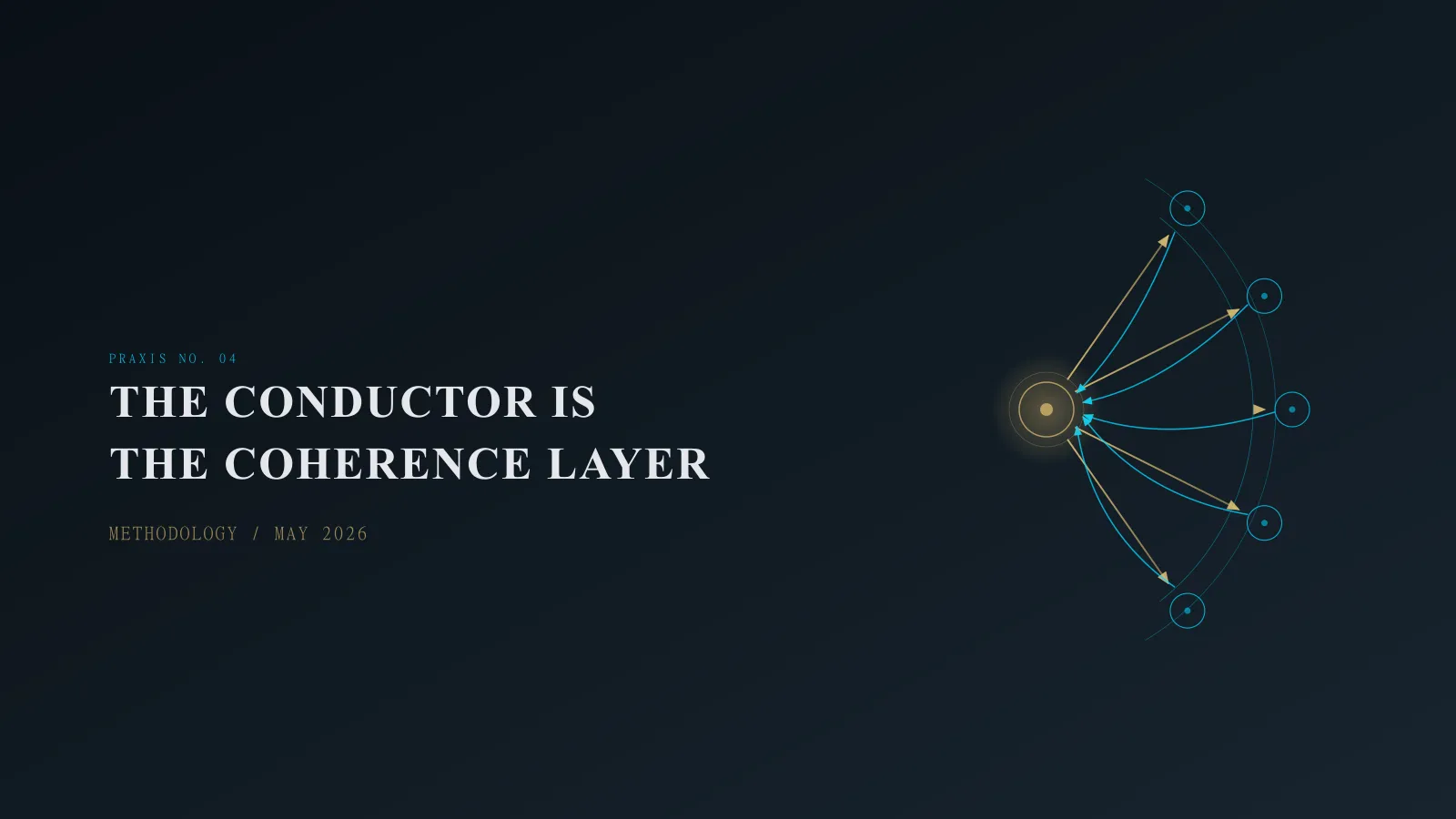

There is a failure state most practitioners working across multiple AI surfaces are living inside without being able to name it. Multiple tools. Reasonable outputs from each. A combined result that feels thin, or slightly off, in a way that is hard to locate.
The tools performed correctly. The coherence layer was absent.
The coherence layer is not a tool. It is not a prompt template. It is not a workflow automation. It is the person directing the system — the one who holds the full arc of the work across every surface, every session, every feedback loop.
The conductor.
What the conductor holds
An orchestra metaphor is imprecise if it implies passive listening. The conductor of an AI-augmented practice is not monitoring outputs and selecting the best one. The conductor is doing specific, continuous, quiet work that no surface can perform for itself.
State. What has been decided across sessions. What is resolved. What is still open. No surface has access to this unless it is carried in. A session that opens without its current state is a session reasoning from zero, no matter how capable the model underneath it is.
Contradiction detection. One surface assumes something another surface has already invalidated. The gap is invisible to both because neither has access to what the other produced. The conductor sees both. The conductor catches it. Or the contradiction ships.
Drift correction. A surface begins pulling in a direction that does not fit the current shape of the work. The pull is subtle — a framing shift, a scope expansion, a tonal drift that accumulates across paragraphs. In the first few sentences the cost of correction is low. By the end of a session it is high. The conductor catches drift early or pays for it late.
Translation. The output of one surface does not arrive at the next surface as raw text. It arrives as a translation, carrying the relational meaning of what just happened into the next environment, so the receiving surface operates on a live position rather than a stripped artifact. This is the difference between copying output and carrying context. The conductor performs this translation at every handoff.
Every piece of coherence the system exhibits comes from the person directing it. The surfaces cannot do this for themselves. They have no access to what they cannot see. They cannot detect drift from an intent they were never shown.
What this demands
The cognitive profile this work selects for is specific. It is not about speed, volume or technical fluency with any particular tool. It is about the ability to hold an entire system architecture in working memory while simultaneously directing its execution across multiple surfaces in real time.
Some minds process complex systems as structural patterns rather than linear sequences. They think in architectures, dependencies and misalignments. For most of human history that wiring had no matching interface. Conventional workflows — sequential, role-divided, built for linear handoff — were not designed for how this kind of cognition operates.
AI-augmented practice inside professional tooling is the first execution layer that matches. Not because the tools are faster. Because the tools externalize and preserve the work at a fidelity that working memory alone cannot sustain, while the mind that holds the full structure continues to direct, test and reshape it in real time. The density of what can be operated on at once increases — not because cognition has been offloaded, but because the surface area available to it has expanded.
846,000 lines of production code. One operator. Three months. The operator held the system in his head. The AI held the files in its hands. That sentence is not a metaphor. It is a precise description of the division of labor between architectural cognition and execution infrastructure.
The connection to the operating model
Praxis No. 01 made the claim that Sarif is one operator and one intelligence layer. This note names why that model works, rather than merely survives.
It works because coherence is not distributable. You cannot split the conductor role across three people and preserve the same coherence. Each person holds a partial model of the work. The partial models overlap imperfectly. The gaps between them are where Coherence Decay Coherence Decay The degradation that occurs when work passes through too many hands, too many meetings or too many translation layers. Every handoff strips context. Every summary compresses nuance. By the time a strategy reaches execution, or a diagnosis reaches the decision-maker, most of the original signal has been lost. Coherence decay is why large firms produce thick decks with thin insight. Related Trace Jensen Metabolic Knowledge Referenced by Metabolic Knowledge UCIM — Universal Contextual Intelligence Matrix Trace Briefing Praxis Open in atlas enters — not through incompetence, but through the structural impossibility of three minds holding the same full-system state simultaneously.
Jensen Jensen Jensen is Sarif's intelligence layer. A graph-grounded reasoning system that metabolizes every engagement's context into a persistent operating memory. Jensen is how a single operator runs work that would otherwise require a team: research, synthesis, modeling, strategy, documentation and risk analysis are orchestrated through one coherent substrate rather than distributed across disconnected roles. Related UCIM Metabolic Knowledge Trace Referenced by Augment Your Intelligence Coherence Decay UCIM — Universal Contextual Intelligence Matrix Trace Open in atlas is not a second conductor. Jensen is the orchestra: the analytical infrastructure that researches, synthesizes, models, cross-references and preserves. The principal conducts. The division is total. One mind holds the arc. One layer holds the evidence. Neither substitutes for the other.
1:1
This is the operational meaning of Augment Your Intelligence Augment Your Intelligence Sarif's operating principle. A consulting engagement should not hand a client an artifact and walk away. It should install an intelligence layer that persists, adapts and compounds. Every deliverable, every session, every decision flows through an augmented cognitive substrate that the client can reason against long after the engagement ends. Related UCIM Jensen Trace Open in atlas . Not AI replacing thought. Not AI accelerating output. AI expanding the surface area available to thought, so that a single practitioner can operate at a density and across a duration that the mind alone cannot sustain. The thinking remains the practitioner’s. The fidelity of what surrounds the thinking — the evidence, the memory, the cross-referencing, the Trace Trace The full record of how a conclusion was reached. For Sarif, every deliverable carries a trace: which sources were consulted, which concepts activated, which inferences were labeled as grounded, inferred or uncertain, and which risks were flagged along the way. Trace is not appendix material. It is the audit surface that makes the conclusion trustworthy. Related Epistemic Mode Coherence Decay Jensen Referenced by Augment Your Intelligence Coherence Decay Metabolic Knowledge Jensen Epistemic Mode Briefing Praxis Open in atlas — is what the layer provides.
What the conductor produces
Something specific happens when this system is genuinely flowing. Reasoning that could not be held alone becomes visible. Not because the tools are smarter than the practitioner, but because the tools are externalizing and preserving the work at a resolution that working memory cannot maintain unaided. Connections across domains surface. Structural weaknesses reveal themselves under adversarial pressure from downstream surfaces. Positions that felt complete in the first pass turn out to be incomplete once the system circulates.
The output is not the product of the conductor’s thinking alone. It is not the product of the tools alone. It is the product of the relationship between them — the conductor holding coherence, the surfaces holding fidelity, the circulation carrying state updates between them until the position stabilizes.
That relationship is what Sarif delivers. Not tools. Not hours. Not a team. A Metabolic Knowledge Metabolic Knowledge Knowledge that an organization actively digests rather than passively stores. A wiki is not metabolic. A Slack archive is not metabolic. Knowledge becomes metabolic when it feeds back into decisions, gets reinforced by outcomes and decays when it stops being useful. Sarif's engagements install this metabolism; Jensen is the organ that performs it. Related UCIM Coherence Decay Trace Referenced by Coherence Decay Jensen UCIM — Universal Contextual Intelligence Matrix Epistemic Mode Praxis Open in atlas practice where one mind holds the arc and one intelligence layer holds everything underneath it.
What this is not
It is not a claim that the conductor is infallible. A single mind holding the full arc is a single point of failure, and the methodology treats it as one. That is what the return paths described in Praxis No. 03 are for: the surfaces are the adversarial pressure on the conductor’s own position, not merely the executors of it. A conductor who cannot be contradicted by the system is not conducting. They are dictating, and the output will carry every assumption they arrived with.
It is also not a claim that the work is effortless because the tooling is capable. The conductor’s load does not decrease as the surface count rises — it increases, because state, contradiction, drift and translation all scale with the number of environments in play. What the tooling buys is not relief. It is reach.
The conductor is the coherence layer. The layer is the instrument. The engagement is what coherence sounds like when it is flowing.
Every state update, every caught contradiction and every correction is recorded in the Trace that accompanies a Sarif engagement. If you want to see what a conducted system produces on your own problem, send a transmission and we will show you the record.
Continue